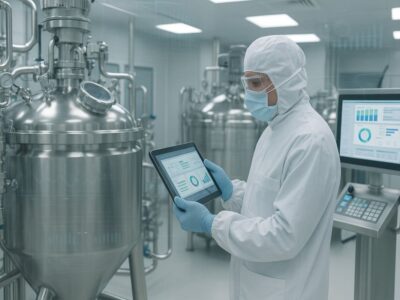
The Mexican cosmetics industry is undergoing a period of profound transformation. Consumers are demanding safer, more innovative, and more sustainable products, while manufacturers face stricter regulations, pressure to reduce costs, and the need to launch new products rapidly. In this context, personal care has become an engine of growth, but also a challenge for companies that must guarantee quality and absolute traceability in every batch.
This is where management software platforms known as Manufacturing Execution Systems (MES) become a strategic ally. This system not only facilitates production planning and execution, but also connects business strategy with what happens on the factory floor, ensuring visibility, regulatory compliance, and efficiency in the manufacturing of cosmetic products.
Challenges of the cosmetics industry
The sector faces multiple challenges that directly affect its competitiveness:
Quality control and regulations
Quality control is the cornerstone of any cosmetics company. Every cream, shampoo, soap , or fragrance must comply with regulations such as ISO 22716 (Good Manufacturing Practices) or FDA 21 CFR Part 11. Ensuring consumer safety is mandatory, but doing so efficiently requires digitalization and robust systems.
Complexity of raw materials
The raw materials used in cosmetics are diverse, sensitive, and expensive. Their traceability is vital to avoid errors, waste, and safety issues. Furthermore, the globalization of the supply chain adds pressure: suppliers from different countries, batches with varying purity, and conflicting regulations.
Costs and efficiency
Manufacturers must compete in a market saturated with brands. Margins depend on reducing waste, optimizing line changeover times, and ensuring consistency between batches. Without digital systems, these tasks are costly and time-consuming.
Comparison with other industries
The pharmaceutical and chemical industries have been digitizing their processes for years. In cosmetics, the pressure is the same: consumer safety, traceability, and efficiency. It's not just about beauty, but about trust.
What is a Manufacturing Execution Software Platform (MES)?
An MES system is a management system designed to monitor, coordinate, and optimize production in real time. It acts as a bridge between ERP software platforms (resources and finance) and plant systems (PLC, SCADA, sensors).
The characteristics of an MES system are:
- Real-time production control
Manage plant planning and execute jobs with up-to-date information on production status and inventory. Respond quickly to unforeseen events and minimize plant downtime. - Monitoring the quality of processes and products
Automate the execution of your quality sampling plan. Apply statistical process control (SPC) methods to visualize quality data and KPIs in real time. Easily identify samples that violate limits and rules. - Cloud Integration
Store, share, and visualize operational data in the cloud. Integrate data from multiple plant MES systems. - User experience modeling
Incorporate information views into your work practices with a low-code HTML5 form designer. Include real-time program compliance and OEE KPIs with decision support to maintain production performance and line productivity. - Plant modeling
Model your plant processes and business rules. Guide workers with process, product, and quality specifications and validation data for the current scheduled work. The model abstracts from the physical processes and provides a consistent user experience for operational activities. - Digitization of workflows
Capture operating procedures and workflows using low-code technology. Automate and ensure the correct and consistent execution of the workflow. Transform and standardize how work is done on the plant floor with a digital user experience on desktop and mobile devices.
USEFUL CONTENT – Digitization of Workflows in the Manufacturing of Personal Care Products
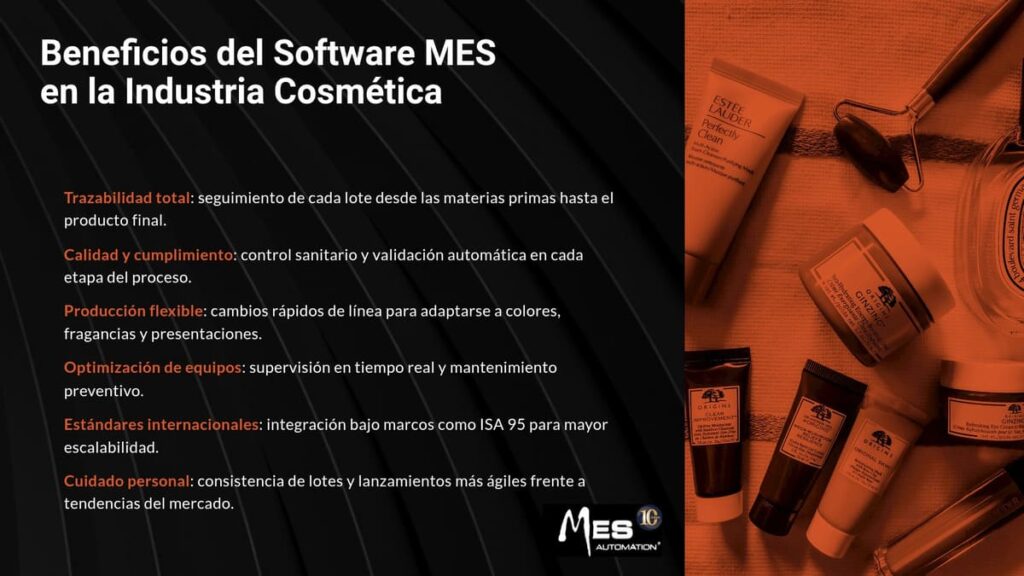
Benefits of MES Software in the Cosmetics Industry
Complete traceability in the supply chain
With MES software, each batch of raw materials is tracked from the moment it enters the warehouse until it becomes the finished product. This strengthens the supply chain , streamlines audits, and allows for targeted recalls in case of problems.
It increases the efficiency of workers and processes
Facilitate worker decision-making with real-time visibility and control of production, inventory, and quality processes.
Improve quality, compliance, and satisfaction
Ensure production is consistent with specifications. Automate quality control. Trace materials from finished product to raw material in minutes.
Gain visibility into all manufacturing operations
Get a unified 360-degree view of your plant or all your plants in the cloud.
Unlocking the value of your data to build smart solutions.
Increased productivity and efficiency
It records performance data to identify and correct bottlenecks.
It allows for real-time production planning and adjustment, optimizing schedules.
It facilitates the automation of tasks and the optimization of resource use.
Costs reduction
Minimize downtime and save energy by detecting excessive consumption.
Reduce the costs associated with defective products.
Quality improvement
It guarantees quality by controlling manufacturing parameters at each stage.
It allows for the rapid resolution of problems by accurately identifying their origin.
Advanced traceability and regulatory compliance
It provides complete tracking of the product journey, from raw materials to the final product.
It facilitates compliance with internal and external regulations by maintaining a detailed history of each production batch.
Data-driven decision making
It provides accurate, real-time information for informed decision-making.
It allows you to calculate key metrics such as OEE (Overall Equipment Effectiveness).
It facilitates the analysis of production at the enterprise level by integrating with systems such as ERP.
Increased visibility and control
It offers complete visibility of the production plant's operations.
It allows monitoring and evaluation of the status of resources such as machinery, materials and manpower in real time.
Other key benefits of MES systems
Benefits for quality
- Complete visibility and real-time control: An MES system allows you to monitor every stage of the production process, from raw materials to finished product. This real-time visibility helps identify and correct quality problems immediately, before they escalate.
- Reduction of human errors: By digitizing and automating production processes, the probability of errors caused by manual intervention is minimized.
- Proactive quality management: The MES not only detects failures, but also allows for the implementation of preventative quality control. This is achieved by establishing control points during the process, alerting supervisors when parameters deviate from defined standards.
- Full traceability: It allows you to trace the origin of each component and material, as well as the processes the product has undergone. In the event of a defect or product recall, complete traceability facilitates the rapid identification of affected batches, limiting the impact.
- continuous improvement: By documenting and analyzing quality data, MES facilitates the identification of areas for improvement in production. It fosters a data-driven continuous improvement cycle, such as the PDCA cycle (Plan, Do, Check, Act).
Benefits for regulatory compliance
- Compliance with quality standards (ISO, GMP): An MES system ensures that manufacturing processes follow standard operating procedures, helping to comply with industry regulations and guidelines, such as Good Manufacturing Practices (GMP) or ISO standards. Electronic Records facilitate compliance with Good Manufacturing Practices (GMP) by eliminating paperwork and generating tamper-proof electronic records.
- Automatic report generation: The system automatically records all the information necessary for audits and certifications. This includes production records, quality controls, and deviations, eliminating manual paperwork and the risk of errors.
- Specification and documentation management: Ensure that only the correct materials and formulas are used in production, and that all quality documentation is up-to-date and accessible.
- Prevention of non-compliance: By monitoring and validating processes in real time, MES helps prevent situations that could lead to non-compliance with regulations, such as the use of unapproved materials or the omission of critical steps.
- Faster response to audits: With all production and quality information centralized and digitized, companies can respond more quickly and accurately to internal and external audits, demonstrating compliance at all times. This provides a complete audit trail and facilitates the documentation required by regulations such as the FDA, EMA, and other health agencies, simplifying inspection processes.
- Integration with LIMS: It can be integrated with a Laboratory Information Management System (LIMS) for quality control of ingredients and final product (microbiological testing, stability, etc.).
Benefits for achieving an improvement / optimization of production
It facilitates detailed scheduling by taking production orders from ERP systems and translating them into detailed execution schedules in the plant, optimizing the allocation of resources (machines, personnel).
Improves real-time machine performance monitoring by capturing real-time data on Overall Equipment Effectiveness (OEE), identifying bottlenecks and enabling analysis for continuous improvement.
It improves resource management by allowing you to control the status and availability of equipment (calibration, maintenance) and manage staff skills and assignments.
It facilitates integration with ERP systems. The MES acts as the vital link between enterprise resource planning (ERP) and on-site execution (control systems), facilitating the exchange of data in real time. It indicates which products should be manufactured and when. This helps the MES determine how to manufacture those products most efficiently and with the required quality, providing the ERP with real-time production data.

ISA-95 and its application in the cosmetics industry
The ISA-95 standard is an international standard that defines how to integrate enterprise management systems with plant control and automation systems in a structured way. Its most common representation is a five-level pyramid, which describes everything from field sensors to corporate management systems.
Applied to the cosmetics industry , this model allows us to understand how the MES system is at the heart of digital integration and ensures traceability, regulatory compliance, and production efficiency. The experience accumulated in the chemical industry has served as a reference for adapting these standards to the manufacturing processes of creams, perfumes, and personal care products.
Level 1 – Sensors and devices (I/O Link, DeviceNet, Sensors)
At the base are the sensors and devices that collect data from the process.
For example: temperature sensors in cream mixing tanks, viscosity meters in body lotions, or flow meters that control the dosage of fragrances and colorants. These devices ensure that the conditions defined in the raw material safety data sheets are met at all times.
Level 2 – PLC, DCS and equipment control systems
This is where the PLCs and distributed control systems that automate the machines and processes are located .
Let's look at an example in cosmetics: a PLC that regulates the speed of an agitator in an emulsion reactor, controls the water heating for shampoo, or synchronizes the filling of bottles on a packaging line. Standardization is key to safely handling different chemicals used in cosmetic formulations.
Level 3 – Supervision (HMI, SCADA, Batch Systems)
Monitoring systems allow operators to view and control production in real time.
Cosmetics example: A SCADA system that monitors the progress of a batch of facial cream, triggers alarms if the temperature drops below the set range, and allows the process to be stopped to correct deviations. This monitoring is achieved through digital control , which integrates data from sensors and automated systems for immediate response.
Level 4 – MES and operating systems
At this level are the MES along with other support systems such as LIMS (laboratory), WMS (warehouse), CMMS (maintenance) or QMS (quality).
Cosmetics example: The MES manages the digital recipe for a batch of anti-wrinkle cream, validates that the raw materials are within specifications, guides the operator in dosing, records critical parameters, and automatically generates the electronic batch record. It also communicates with the WMS to release containers and with the QMS to document quality controls.
Level 5 – ERP and business logistics
At the top is the ERP , which manages sales, finance, purchasing and logistics, coordinating with the MES to transform plans into actual execution.
Cosmetics example: Upon receiving an order for 50,000 units of moisturizing cream, the ERP system converts it into a production order and sends it to the MES (Manufacturing Execution System), which organizes shifts, equipment, and materials. The ERP then manages invoicing and distribution to points of sale.
Specific MES functionalities for cosmetics
The MES offers modules adapted to the reality of the cosmetics industry and its close relationship with the chemical industry; these systems focus on managing the complexity of formulas, batch traceability, and strict quality control and regulation.
- Management of raw materials and chemicals. Recording of batches, expiration dates, and purity of each ingredient. Recipe management to ensure that the correct ingredients are used in the proportions according to the recipes/parameters. Control of raw material batches used in each production order.
Monitoring of raw material stock and its movement in WIP (Working Process) areas, for both reception, transfers and exit. - Formula and Recipe Management Precise formulation is fundamental, so it is important that the MES system: Allows the creation, management and control of complex multi-level formulas (recipes), ensuring that the correct ingredients are used in the exact quantities, which is vital for the consistency and quality of the product (color, texture, etc.).
Enables Guided Dosing and Weighing: The system integrates with scales and dosing equipment to guide operators step by step, verifying the identity and quantity of raw materials added to the mix, minimizing manual errors. - Online quality control. Viscosity, temperature, and homogenization monitoring. Execution of quality controls and checklists using the application at operating terminals on the shop floor. Integration of automatic quality controls (e.g., with weighers, machine vision, counts).
Non-conformity management and verification of process parameters such as temperature and humidity.
Real-time alerts are issued when problems, specification violations, or non-conformities are detected. Parameter Monitoring: Monitors and records critical process variables (temperature, mixing time, pH, pressure) in real time, activating visual alerts if values are outside the defined tolerance. Non-Conformity Management: Allows for the recording and tracking of deviations or quality problems, facilitating immediate corrective action. - Batch Traceability and Genealogy Complete Traceability: Tracks each batch of finished product from the origin of its raw materials (specific batches of ingredients, packaging) to its distribution.
Product Genealogy is a key capability: Creating a detailed production history (Electronic Batch Record or eBR), which includes who did what, when, with what equipment and what quality results were obtained, is crucial for audits and potential product recalls.
Additionally, features such as the following can be incorporated:
- Workflow management. Task automation, electronic guides, and alerts for operators.
- ISA 95 applied to cosmetics. Connecting corporate levels (ERP) with the plant to achieve a unified ecosystem.
- Inventory control. Integration with warehouses to avoid shortages or excess stock.
- Industry-specific expertise. Adaptation of the MES to regulations and particularities of cosmetics and personal care.
- Innovative technologies. Integration with Big Data, artificial intelligence and computer vision.
Practical example: production of face cream
Let's imagine a personal care company that produces moisturizing cream in three fragrance variants.
- The ERP sends the production order to the MES.
- The system checks availability of raw materials and releases the order.
- The recipe manager guides the operator in the dosing of ingredients.
- During mixing, the MES controls viscosity and temperature.
- The production equipment They notify the system of any deviations.
- After a batch is completed, cleaning protocols are executed according to GMP and the line is prepared for the next variant.
- The system automatically generates the digital batch record with full traceability.
This process complies with ISA 95 guidelines , connects the laboratory with the plant, and ensures an agile workflow, meeting the demands of the chemical and cosmetic industries.
Integration with other technologies
The value of the MES system increases when integrated with additional systems:
- ERP software. Automated flow of orders, inventories and costs.
- Manufacturing Intelligence. Advanced analysis to optimize times and detect bottlenecks.
- LIMS in the pharmaceutical industry. Connection with laboratories to release batches faster.
- Big Data and innovative technologies. Demand forecasting, energy consumption analysis, waste reduction.
- Real-time compliance control. Guarantee that each batch meets regulations before being released.
- Project monitoring. The MES coordinates tasks, responsibilities and deadlines in continuous improvement projects.
Economic and operational impact
The benefits of the MES translate into concrete figures:
- Waste reduction: 10–20%.
- OEE improvement: up to 15%.
- Line changeover times reduced by 30%.
- Faster audits thanks to electronic documentation.
- ROI in 18–30 months.
For personal care companies , this means being more competitive in a market where innovation is constant. For the chemical industry , the value lies in risk reduction and regulatory compliance.
Keys to a successful implementation
- Define objectives: reduce waste, comply with regulations, accelerate launches.
- Involve all areas: production, quality, IT and management.
- Select a provider with industry-specific expertise in cosmetics and chemistry, as is the case with MES Automation.
- Train staff and strengthen the skills management.
- Start with a pilot project and scale up gradually.
- Measure results with clear KPIs and ensure that the system maximize your production.
MES Software Integrator for the Mexican Cosmetics Industry
The digital transformation of the cosmetics industry is not optional; it's a matter of survival. Global competition, regulatory pressure, and the rapid pace of changing trends mean that manufacturers need robust tools capable of guaranteeing efficiency, traceability, and compliance.
The MES is that pillar: it ensures quality control , optimizes the supply chain , connects production teams , manages formulas and recipes , incorporates Manufacturing Intelligence , complies with standards such as ISA 95 , and integrates with ERP and LIMS software to achieve an end-to-end connected operation.
However, successfully implementing an MES system depends on more than just the software; it requires a specialized integrator who understands both the technology and the operational realities of the sector. In Mexico, MES Automation has established itself as a strategic partner for cosmetics manufacturers, offering a comprehensive approach that combines technical expertise, regulatory knowledge, and a deep understanding of the dynamics of the chemical and pharmaceutical industries.
As an integrator, MES Automation supports personal care companies in all phases of the project:
- Initial diagnosis to identify gaps in traceability, digital control and process management.
- ISA 95 Architectural Designensuring that the MES integrates with PLCs, SCADA, ERP software and laboratory systems.
- Deployment and configuration of specific modules for the manufacturing of cosmetic productsfrom formula management to health control.
- Training and skills management so that staff can quickly adopt the system.
- Project monitoring and continuous support, guaranteeing progressive improvements and scalability.
In both cosmetics and related sectors—such as the pharmaceutical and chemical industries—MES, with the help of MES Automation , has become synonymous with efficiency, compliance, and competitiveness. Its ability to digitize processes, reduce risks, and accelerate product launches allows cosmetics and personal care brands to stay ahead in a dynamic and demanding market.
Ultimately, adopting a Manufacturing Execution System (MES) with a strategic vision and the support of a specialized integrator like MES Automation is not just about implementing technology: it's about committing to operational excellence, absolute traceability, and the continuous innovation demanded by the new era of cosmetic manufacturing in Mexico. Contact a technical advisor.
Originally published on September 25, 2025, updated on November 5, 2025
 Reliable and Accurate MES Manufacturing Systems Integrator