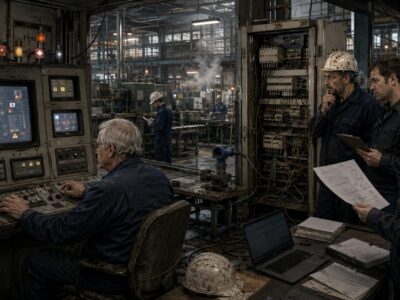
There's a phrase we constantly hear in food and beverage, consumer goods, and automotive plants: "The system works, let's not touch it." It's the most dangerous phrase in manufacturing.
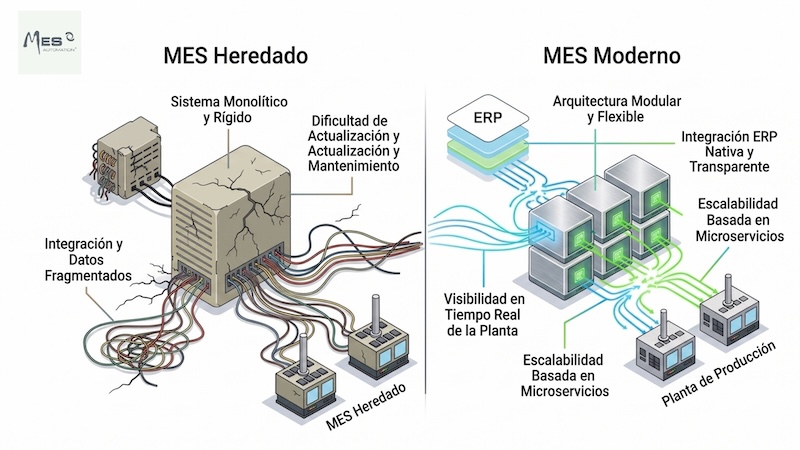
Because while your MES is "working," your bottling line is losing OEE minutes every shift due to reports that take forever to load. While it's "working," an FDA auditor or a Tier 1 automotive customer is finding traceability gaps that shouldn't be there. While it's "working," the only person who understands that code is one notice away from quitting and leaving you without support.
The system doesn't fail all at once. It fails silently, every day, in the form of lost hours, decisions made with outdated data, and accumulated risk that no one sees on the income statement—until there's a line shutdown, a product recall, or a failed audit.
What technical debt really costs your industry
Food and beverages. A legacy MES that doesn't capture complete batch-to-batch traceability isn't just an IT problem: it's the difference between a controlled, localized product recall and one that forces a recall of an entire production run. In an industry where food safety and regulatory compliance (FDA, FSMA, HACCP) are non-negotiable, every gap in traceability is a real legal and reputational risk that damages the manufacturer's reputation.
Consumer goods. Their product lines are constantly changing SKUs—new presentations, promotions, formulations. A rigid recipe management system turns each product change into a project that takes days instead of minutes. This translates directly into a reduced ability to respond to the market compared to more agile competitors.
Automotive. Your OEM customers demand complete traceability, IATF compliance, and real-time visibility into quality at every station. An MES that doesn't natively integrate with PLCs, sensors, and corporate systems turns every customer audit into a race against time to reconstruct information that your system should already have readily available.
In all three cases, the pattern is the same: outdated technology not only costs more to maintain — it directly limits your ability to sell, deliver, and grow.
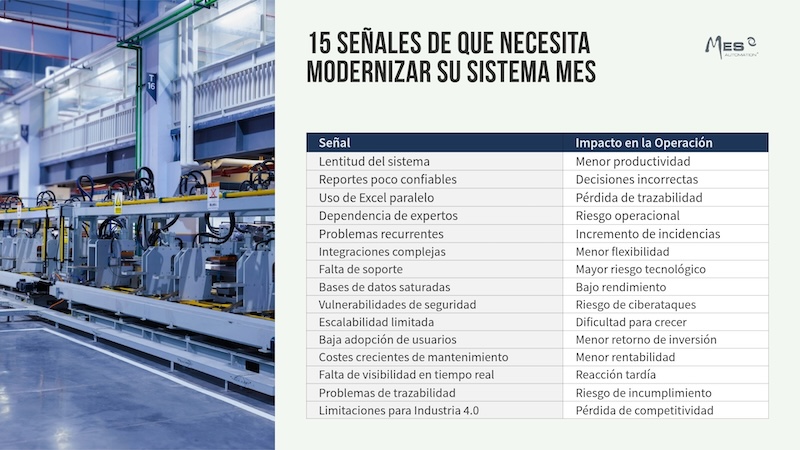
15 signs your plant is already paying the price
If your team identifies with three or more of these signs, the conversation about modernization should already be on the management agenda, not just the IT agenda.
- Only one or two people "know how to play" the system. If that person leaves, their plant will be operating blindly.
- Operators record everything in Excel or on paper "just in case." It is the clearest sign that nobody trusts the official system anymore.
- Reports take minutes to load instead of seconds, and that time is multiplied by each shift, each line, each day.
- There are alarms that nobody understands or heeds.because they became background noise instead of actionable information.
- The provider no longer offers official support. — any critical failure becomes a problem with no one to call.
- Connecting a new line, sensor, or ERP takes weeks when it should take days.
- Production reports do not match what is actually happening on the shop floor.And decisions are made with data that no one fully verifies.
- Changing a formula or recipe is an operational headache, instead of a simple on-screen adjustment.
- Reconstructing the history of a batch takes hours of manual work instead of seconds of consultation.
- The system does not support a new line, shift, or plant. without projects for months.
- Maintenance costs increase every yeareven if production does not grow at the same rate.
- Nobody has applied a security patch in years.
- Operators avoid using the system because it is slow, confusing, or not intuitive.
- There is no real-time visibility — you find out about a quality problem hours after it happened.
- Every time you want to innovate — AI, analytics, IIoT — the system is the obstaclenot the enabler.
You don't always have to replace everything: there's a solution tailored to your plant
Modernizing doesn't necessarily mean scrapping the current system and starting from scratch. For many plants, the right path is gradual:
- Technological update of the most critical and risky components.
- Application reengineering existing ones to extend their useful life.
- Integration with modern platforms — ERP, cloud, analytics — without replacing the entire ecosystem.
- Partial replacement of the modules that are actually slowing down the operation.
The right decision depends on a real diagnosis, not intuition. That's why the first step is always a technical audit that evaluates applications, servers, databases, integration, security, and industrial communications—to build a roadmap based on real risk, not assumptions.
What your plant gains by modernizing
- Complete traceability From batch to batch, ready for any audit — be it FDA, automotive customer or quality certification.
- Recipe and SKU changes in minutesnot in days, to respond to the real pace of the consumer market.
- Native integration With ERP, sensors, PLCs and corporate systems, without endless projects.
- Real-time visibility of production, quality and asset performance, to make decisions based on current data, not yesterday's.
- Reduced exposure to cybersecuritywith updated and supported systems.
- A technological foundation ready for AI, advanced analytics, and predictive maintenance — not as a future promise, but as a capability available today.
MES AUTOMATION: Modernization without jeopardizing your production
We know that resistance to modernization is almost never due to a lack of awareness of the risks — it is due to fear of halting the line, of a project that drags on, or of losing control during the transition.
That's why at MES AUTOMATION we work with an approach designed for plants that can't afford to stop:
- Complete technical audit that identifies real risks before touching a single line.
- Progressive modernizationprioritizing what represents the greatest risk or opportunity first.
- Migration validated with testing and controlled environmentsso that the transition does not compromise its production.
- Strengthening cybersecurity and backup from the first day of the project.
- Ongoing technical support once modernized, so that the investment does not turn back into technical debt in five years.
We work with food and beverage, consumer goods, and automotive plants that understand that modernizing their MES is not an IT expense — it's a competitive decision.
Is your MES system already limiting your plant's growth?
Request an MES Systems Audit and receive a clear technical diagnosis: identified risks, opportunities for improvement, and a concrete roadmap to modernize your platform without interrupting production.
————————————————————————————————————
Frequently asked questions from plant managers
How do I know if my MES needs modernization or can still operate for a few more years? Signs such as slow reporting, dependence on a single key person, lack of vendor support, difficulty integrating new product lines, or cybersecurity risks indicate that it's time to evaluate. A technical audit determines whether it's best to optimize the current system, perform a partial upgrade, or initiate a complete modernization.
What risks do I run if I continue using my legacy MES without updating it? Problems accumulate silently: lost productivity, traceability gaps, security vulnerabilities, and increased maintenance costs. When the system loses official support, any critical failure can become a costly production downtime—or a compliance issue with a client or regulator.
Is it necessary to replace the entire system, or can it be modernized in stages? Not always. Many plants opt for a phased modernization: optimizing databases, updating servers, improving reports, integrating new PLCs, and strengthening cybersecurity in stages. The right path depends on the current state of your system and your growth objectives.
What concrete benefits does my plant gain from modernizing the MES? Greater real-time visibility, fewer operational incidents, audit-ready traceability, strengthened cybersecurity, and a technology foundation prepared for IIoT, advanced analytics, and artificial intelligence—with lower maintenance costs in the medium term.

 Industrial and Manufacturing Software Support in Mexico – The real challenge begins after implementation.