

In modern manufacturing, software platforms have ceased to be support tools and have become the backbone of operations. MES applications, Andon systems, batch solutions, traceability systems , SCADA systems , PLC- integrated solutions , production reports, control panels, and automation logic are no longer "support" tools. They are an integral and direct part of the production process flow.
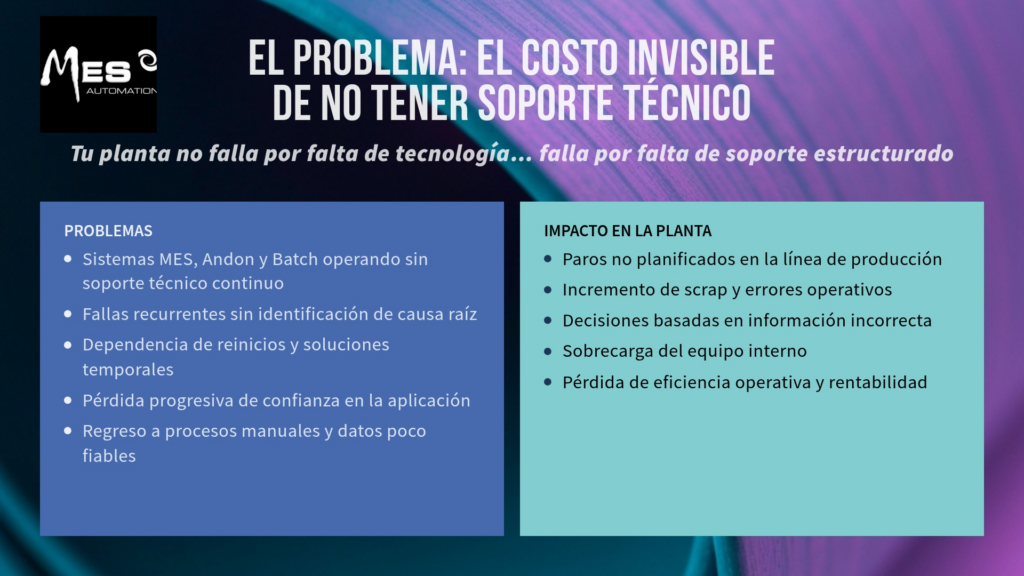
The problem is that in many plants , a critical error persists: treating these platforms as static assets . They are implemented, commissioned, and then left to operate for years with limited technical support, insufficient internal knowledge, and a reactive mindset based on "if something fails, we'll see it." This way of operating generates an invisible cost that doesn't always appear in IT, automation, or maintenance budgets . It manifests as : stopped production , inconsistent reports, loss of traceability, rework, overloaded technical staff, and decisions made with incomplete data.
Not having enterprise-level technical support for manufacturing might seem like a cost-saving measure. But in practice, it can be one of the most expensive decisions a factory can make. In fact, many operations managers don't fully grasp the risks until they're already facing a critical shutdown or a loss of traceability. If you want to delve deeper into these risks , you can review the details of the Dangers of Not Having an Industrial Software Maintenance Service , which analyzes the most common scenarios that directly impact production.
The real risk is not that industrial software will fail, but not being prepared when it does.
A poorly maintained industrial platform doesn't always crash suddenly. Sometimes it starts to fail silently. A service stops capturing information from the PLC. A report stops accurately reflecting a critical variable. A batch recipe is modified without standardized criteria. An operator reverts to filling out manual forms because "the system no longer inspires confidence." A server begins to show signs of obsolescence. An update is left pending for months. A recurring alarm becomes normalized.
And when the outage finally occurs, the response is usually the same: restart the application, restart the server, restart the service, or wait for it to "come back online." But the key question is: was the root cause identified? If the answer is no, the system didn't solve the problem. It only postponed it.
That's where the real hidden cost begins: recurring failures, staff wasting time diagnosing without the necessary tools, operators losing faith in the application, supervisors reverting to Excel, and technical teams constantly putting out fires. Therefore, a professional support model shouldn't be seen as occasional assistance, but rather as a safety net for the continuity of plant operations.
MES, Andon, and Batch Applications: When Operational Deterioration Becomes the Norm
In a batch application, for example, the lack of specialized technical support can lead to recipes created without oversight, unnecessary variations, poorly designed sequences, or parameters that don't follow a standardized logic. Over time, the application becomes heavier, less manageable, and more vulnerable to human error.
In an Andon system, the problem can be even more dangerous: if the automatic stop data capture fails or if the system loses connection with the PLC, the operator may revert to manual methods. The result is a disconnect between the reality of the production line and the data used for decision-making.
The factory believes it has visibility, but in reality, it operates with incomplete information. And if there isn't a management cycle associated with the application—root cause analysis, downtime analysis, corrective actions, and follow-up—the system becomes a pretty dashboard that no one uses to improve. Technology alone doesn't transform operations. What transforms operations is a well-maintained, well-used platform that is aligned with the plant's actual processes, quality parameters, and operational efficiency goals.
The cost of inaction: work stoppages, rework, and loss of trust
Not having technical support for your industrial software applications in your manufacturing activities might seem like a cost-saving measure. But in practice, it can be one of the most expensive decisions a factory can make. Every hour of unplanned downtime can represent lost production, missed deliveries, overtime, waste, scrap, reduced operational efficiency, and increased strain on maintenance, automation, and operations teams.
Furthermore, when an industrial software platform starts to malfunction and is not properly addressed, an even more serious effect occurs: a loss of user confidence. The operator stops using the system. The supervisor stops trusting the reports. The manager stops making decisions based on that data. And the initial investment in industrial software begins to lose value.
The problem isn't just technical. It's operational, financial, and strategic. That's why IT technical support, when applied to an industrial environment, must combine diagnosis, troubleshooting, continuous improvement, and long-term support.
The challenge of maintaining legacy systems in a cloud, edge, and cybersecure environment
Factories are under increasing technological pressure. Industrial architectures are evolving toward more connected models, where local servers, cloud platforms, edge computing, SCADA, MES, PLCs, databases, dashboards, analytics, and enterprise systems coexist. This technological infrastructure demands governance, visibility, updates, and industrial-grade judgment.
In this context, maintaining outdated applications not only affects performance but also increases cybersecurity risk. Many industrial vulnerabilities are related to the lack of hotfixes, service packs, security patches, and manufacturer updates. If no one reviews the platform lifecycle, validates compatibility, and plans for secure windows, the plant can be left exposed.
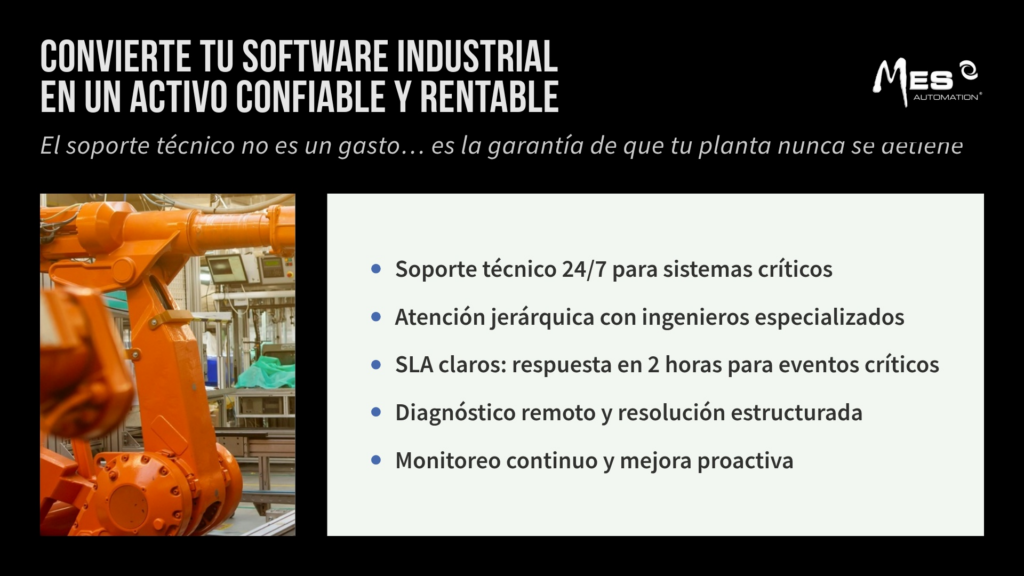
A good specialized technical support program for industrial software applications goes beyond simply answering calls. It helps keep the platform updated, stable, secure, and ready to evolve. And it must do so by understanding the difference between traditional IT support and industrial service: here, the impact isn't just that a user can't access a system; here, industrial manufacturing can grind to a halt.
What should a serious industrial software support program include?
A specialized technical support program for industrial software platforms must begin with an initial assessment. An application cannot be properly supported without understanding how it is built, what technological infrastructure it runs on, and how it is used in operations.
This diagnosis should review servers, performance, architecture, application logic, PLC connection, screens, reports, alarms, variable history, actual use by operators, supervisor needs, and problems detected by automation, maintenance, information technology, and production.
In third-party applications, it may even be necessary to analyze backups in a development environment to detect bad practices, unused screens, unnecessary tags, excessive memory consumption, vulnerabilities, performance problems, or configurations that prevent reliable coverage.
From there, the service must offer clear coverage: Priority Customer Support by email, unlimited calls for site-defined contacts, remote technical assistance during office hours for downtime or loss of functionality, 24/7 coverage for critical applications, online ticket generation and tracking, a knowledge base in Spanish, quarterly performance reports, and service visits to review topology and plan upgrades.
It should also consider:
- Preventive maintenance.
- Corrective maintenance.
- Scheduled preventive maintenance.
- Software update.
- Data security review.
- Remote access validation.
- Data recovery where applicable.
- Systems management.
- Monitoring of services and coordination with software providers.
It can even connect with Asset Management activities, evaluation of existing equipment, enterprise computing equipment, Structured Cabling and technological infrastructure when these elements directly affect the stability of the application.
SLA, escalation, and metrics: support that can be measured
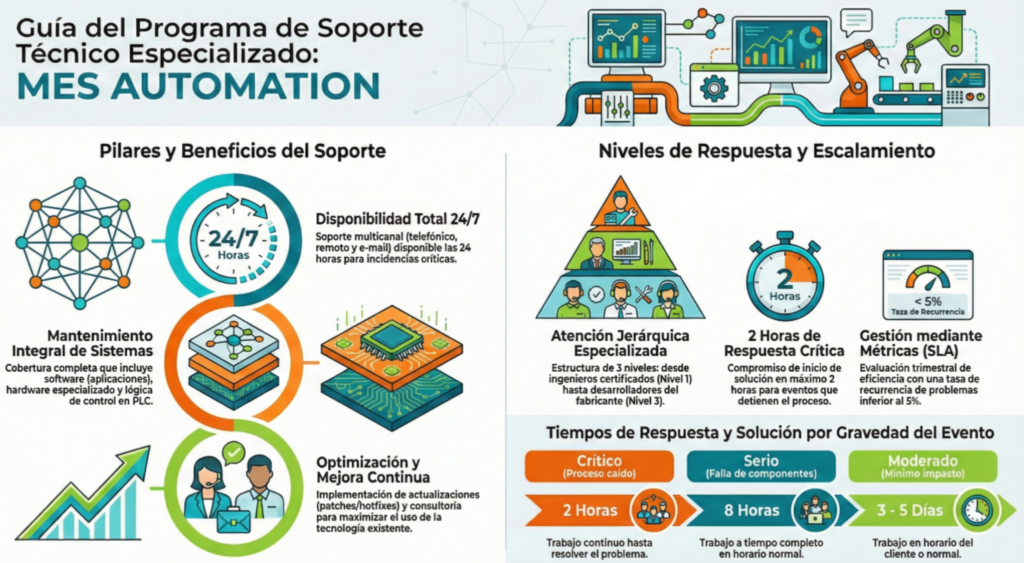
Industrial services must be managed with clear levels of criticality. A critical event, where the process is down, demands an immediate response and continuous work until the problem is resolved. A serious event, such as a component failure or partial loss of functionality, requires structured attention. A moderate event, with minimal impact, can be managed within a normal working window.
But the important thing isn't just responding. The important thing is measuring the recurrence rate . An industrial software support/maintenance contract should define service level agreements, response times, escalation criteria, incident management, and recurrence metrics. For example, if the same ticket is opened twice, the root cause is still there.
A structured program should report how many tickets were generated, how they were categorized, how long they took to resolve, what root cause was identified, what corrective actions were taken, which cases remain open, and whether there is any recurrence. The recurrence rate is critical. If the same problem reappears, it hasn't truly been resolved.
Here, the technical support team must work with application specialists, specialized technicians, and, when necessary, developers or manufacturers. The knowledge base allows for documenting each case, accelerating troubleshooting, and preventing the loss of technical knowledge. Furthermore, a knowledge base in Spanish helps operators, supervisors, and technical managers better understand corrective actions.
From reactive support to long-term strategic partner
The greatest value of a service program lies not only in repairing failures. It lies in becoming a technical and strategic support network for the plant. When the partner understands the operation, the applications, speaks the language of manufacturing, and maintains continuous contact with production, maintenance, automation, and IT, they begin to identify opportunities for improvement that go beyond basic support.
It can identify when a server is nearing the end of its lifecycle. It can recommend an upgrade. It can detect when an Andon application needs to connect directly to the PLC to avoid manual data entry. It can suggest report improvements, alarm adjustments, new visualizations, or small changes that increase the system's actual usability.
At this point, support ceases to be an expense and becomes a driver of continuous improvement. Asset Management stops being a passive inventory and becomes a tool for anticipating risks. Asset Management allows you to know which applications, servers, licenses, versions, interfaces, and dependencies support operations. Asset Management also helps decide when to modernize, when to migrate, and when to extend the lifespan of a solution. Well-integrated with support and maintenance, Asset Management helps protect manufacturing quality and the continuity of production lines.
This approach differs from generic IT outsourcing or user-focused IT support. In a factory, the technical support team must understand production, area automation, PLCs, MES, SCADA, recipes, reports, traceability, and software performance.
How to calculate the ROI (return on investment) of the support
The ROI of the service is best understood when compared to the cost of not having it. What is the cost of an hour of plant downtime? How many times a year does the application stop? How long does it take the internal team to diagnose? How many problems are resolved by restarting without identifying the root cause? How much scrap is generated by incomplete information? How much time do operators and supervisors waste filling out manual forms?
When those losses are valued and annualized, the program typically pays for itself. Asset Management helps complete that calculation because it allows you to identify which components carry the most risk.
Asset management also allows for prioritizing investments and justifying upgrades to management. In practice, asset management transforms IT support into a business conversation, not just a technology discussion.
Do not operate without a support network for your critical systems
Industrial software platforms are too important to be left to operate without specialized support. MES, Andon, Batch, traceability, SCADA, and PLC-connected applications are directly involved in the factory's operational continuity. If they fail, it's not just a system that fails. It's the ability to produce, measure, control, report, improve, and compete against others who may be doing better.
Therefore, the service should not be viewed as an administrative procedure. It should be seen as a strategy to protect profitability, reduce operational risk, ensure continuity, extend the useful life of applications, create a valuable knowledge base, and extract maximum value from specialized programs.
The question is not whether your factory can afford this type of coverage.
The real question is: what does it cost you to not have quick and effective repairs when a critical failure occurs at 2:00 in the morning?
Request a free consultation with our specialists in software maintenance and IT support for industrial applications.
 Industrial Software Support Contract: what it includes and how it prevents plant failures

